Large Tree Removal Near Power Lines and Structures
How high-risk trees near power lines and buildings are removed safely — controlled rigging, utility coordination, crane use, and low-impact yard protection.
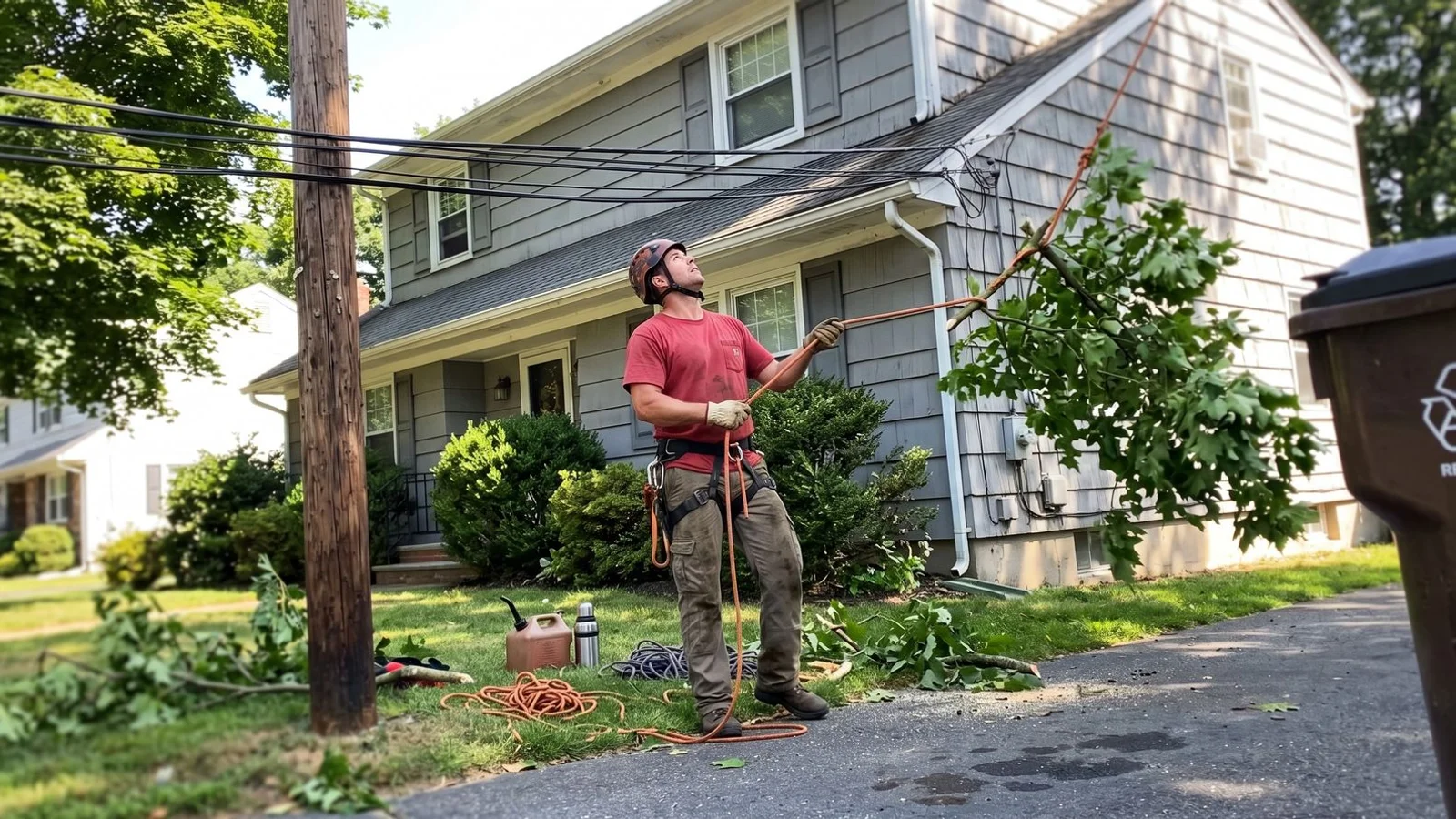
Technical Removals Are a Different Kind of Job
We know that planning a large tree removal near power lines creates immediate stress for property owners. Every tree removal carries some level of risk, but working in tight spaces multiplies the stakes significantly. Specialized crew training, precise equipment, and airtight insurance policies make all the difference here.
Our team will break down exactly how these high-risk jobs work and share practical ways to protect your property during the process.
Let’s look at the data to understand the risks and explore the best methods for handling these complex projects safely.
The Three Big Risk Multipliers
We see three main factors that drastically increase the danger of any job. Power lines, residential structures, and tight access zones all demand specialized approaches.
1. Power Lines
Recent 2025 Occupational Safety and Health Administration data shows that nearly 20% of fatal landscaping incidents involve electrocution from overhead power lines. A single misstep here creates a life-safety event, starts fires, and cuts electricity to the entire neighborhood. Crews without documented utility experience have no business working near active lines.
2. Residential Structures
Our teams never take chances with residential structures. A limb dropped incorrectly onto your roof often causes severe structural damage. Insurance industry figures from 2025 indicate that the average fallen tree claim involving a structure exceeds $10,000.
3. Tight Access Zones
We frequently operate in the tight access zones found throughout older Westchester communities like Bronxville, Larchmont Manor, and Scarsdale Fox Meadow. These historic properties feature restrictive lots filled with mature specimen trees. Small drop zones demand absolute precision to prevent accidental property damage.
How We Handle Large Tree Removal Near Power Lines
We follow strict protocols for trees growing within the utility clearance distance of energized lines. Con Edison specifications for Westchester County require a 15-foot clearance above the wires, 10 feet to either side, and 10 feet below. Any work within these zones requires careful planning.
Our crews use several key steps to manage these utility-adjacent projects safely:
- Coordination with Con Ed or the local utility long before the actual service date.
- De-energization requests for situations where limbs directly touch or overhang active lines.
- Line-clearance-qualified personnel specifically trained for work near energized conductors.
- Controlled rigging techniques to prevent any contact throughout the sectioning process.
These protective steps prevent costly electrical disasters.
We remind property owners that utility de-energization is scheduled in advance rather than provided on-demand. Plan on a one to two week lead time for these coordinated power shutdowns. This scheduling ensures the safety of everyone on the block.
Rigging Explained
We use advanced rigging systems to control every single ounce of wood from the initial cut down to the ground. This technical approach replaces the dangerous method of simply cutting a branch and hoping it falls correctly. A single mistake with a 500-pound limb can destroy a prized garden in seconds.
Our rigging operations rely on specific, load-rated equipment to manage extreme weights.
- Anchor points: Set high in the canopy above the targeted section.
- Arborist blocks: Specialized pulleys that route the falling section’s massive weight safely through the anchor.
- Friction devices: Tools like a Port-a-Wrap allow the ground crew to easily manage tension and lowering speed.
- Portable winches: Essential power systems for lifting or guiding very heavy trunk sections.
Precision equipment prevents unpredictable swings and drops.
We guarantee that proper rigging can lower massive limbs without a single leaf touching your azaleas below. Bad rigging practices explain why inexperienced tree companies frequently leave crushed hedges and damaged hardscapes behind. These careless mistakes are entirely avoidable.
When a Crane Is the Right Call
We frequently recommend crane-assisted removal for the most hazardous or poorly positioned trees. Using heavy machinery transforms a highly dangerous operation into a smooth, controlled extraction. This method is particularly valuable in densely packed suburban neighborhoods.
Our arborists suggest bringing in a crane under several specific conditions:
- The tree exceeds 60 feet in height with a very heavy, sprawling canopy.
- Access to safe drop zones on the property is severely limited.
- The trunk or major limbs lean directly over a residential structure.
- Speed and safety metrics both improve significantly with a mechanical pick.
Equipment choices matter immensely for property protection. A crane lifts sections cleanly away from the structure rather than dragging them through the canopy. This vertical lift strategy protects your roof and accelerates the entire timeline.
We know that a standard removal gone wrong can easily trigger a $12,000 property damage claim, but a crane prevents those impacts entirely. Property owners should also plan ahead, as municipalities like the Town of Ossining require a 15-day advance notice for tree removal permits. Checking local laws early keeps the project moving smoothly.
Low-Impact Yard Protection
We prioritize low-impact techniques to protect your surrounding landscape during every technical removal. Heavy equipment can easily compact topsoil and ruin delicate root systems if left unmanaged. Proper ground protection preserves the health of your lawn and garden beds.
Our standard yard protection plan includes multiple layers of defense.
- High-density track mats and thick plywood placed over turf where heavy machinery drives or parks.
- Breathable physical coverings for nearby gardens and fragile specimen shrubs.
- Careful equipment routing plans designed to avoid softscape areas entirely.
- Comprehensive site cleanup featuring a detailed rake and final blow-down.
These protective services are always included in the bid. Confirming these details upfront provides total peace of mind before the saws start running.
We encourage Bronxville and Scarsdale property owners with valuable landscaping to ask about these specific plans during the initial estimate.
Insurance & Liability
We carry comprehensive insurance policies because standard homeowner coverage leaves massive gaps for tree-related accidents. Most property insurance policies cap tree debris removal reimbursement at just $500 to $1,000 per tree. An under-insured contractor causing structural damage can easily stick you with a devastating out-of-pocket repair bill.
Our team maintains strict liability standards for every single high-risk project.
- Active Westchester County Home Improvement Licenses verifying our legal operating status.
- High-limit general liability coverage built specifically for arboricultural operations.
- Workers’ compensation policies actively covering every crew member on your property.
- A formal written scope of work and a transparent change-order process.
- Extensive photo documentation collected before, during, and after the job.
Property owners should never allow a crew onto their lot without reviewing these active credentials. A quick verification step prevents catastrophic financial surprises down the line.
We provide a verified certificate of insurance directly from our provider upon request before any work begins.
The Cost Reality
We want to be completely transparent about the financial side of a technical tree removal in Westchester. These complex jobs generally cost 30% to 100% more than a standard open-yard cut, depending entirely on the site’s complexity. This price difference reflects the necessary setup time, specialized heavy equipment, and advanced crew skill required for safety.
Our estimators see plenty of dangerously low bids in the market. If a quote for a tree removal near your house matches the price of an open-yard project, the contractor has either misunderstood the assignment or plans to cut essential safety corners. Neither scenario ends well for your property or your wallet.
We always recommend scheduling a detailed, on-site evaluation to get an accurate assessment of your specific situation. You can reach our team at 914-907-4131 to request an estimate for a large tree removal near power lines or directly over your roof.
Additional Resources
For more information, please review our comprehensive guides on standard tree removal, specialized crane-assisted removal, and an exact breakdown of what happens during a tree removal.