Tree Removal vs. Saving the Tree
When a tree is salvageable and when removal is the safer call. Compare cost and risk against alternatives like cabling, pruning, and health treatment.
The Honest Answer
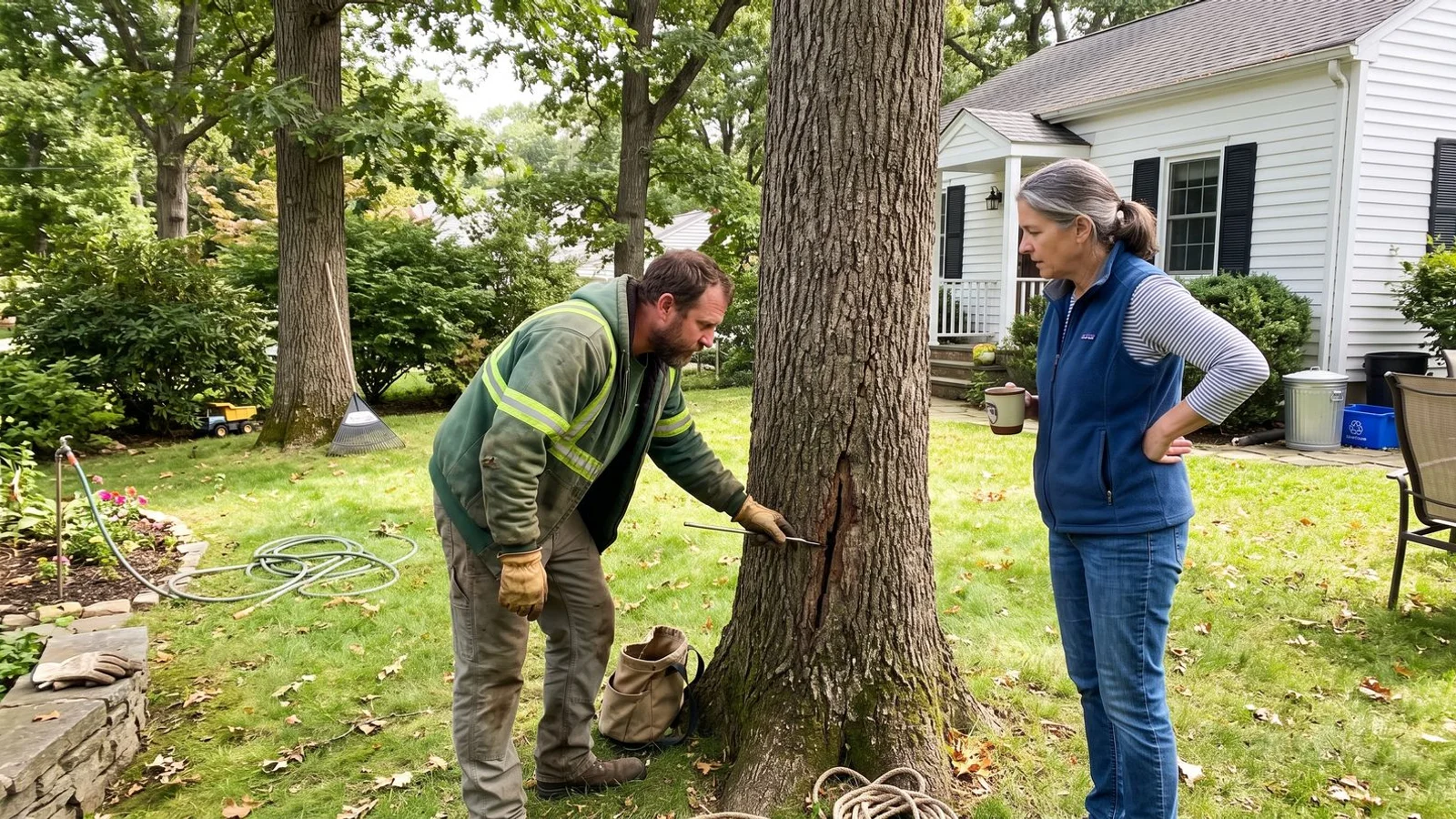
Some trees can be saved. Some can’t. And the difference isn’t always obvious from the ground.
Our job on a preservation-versus-removal decision is to give you both options with real costs, real risks, and a clear recommendation — not to steer you toward whichever service pays us more. If a tree can be safely saved, we tell you.
When a Tree Can Usually Be Saved
- Structural defect is isolated (one weak union, one split limb)
- Overall tree health is good
- Enough sound wood remains in the trunk (roughly 2/3 or more)
- No serious root damage
- Realistic target — the tree isn’t hanging directly over a bedroom
Preservation options: pruning to remove weak limbs, cabling and bracing for split unions, treatment for treatable diseases.
When Removal Is the Safer Call
- Multiple structural defects on the same tree
- Extensive internal decay (hollow tapping across large sections)
- Advanced disease that isn’t treatable (heart rot, advanced Armillaria)
- Root failure with soil heave
- Tree is dead or dying past the recovery point
- Fall path threatens a bedroom, living space, or high-traffic area
Cost Comparison
Preservation (assessment + pruning + cabling): $500 to $2,500 upfront, plus $150 to $500 every 2–3 years for follow-up inspection.
Removal (tree removal + stump grinding): $500 to $5,000+ once.
Preservation is often cheaper up front but adds monitoring cost. Removal is one-and-done. For a valued specimen tree, preservation may be worth the ongoing cost. For a marginal tree, removal is usually smarter economics.
Risk Comparison
Preservation doesn’t eliminate failure risk — it reduces it. If a tree has a weak union you cable, the cable extends the safe life of the tree. It doesn’t make it a healthy young tree again.
Ask honestly: if this tree failed tomorrow, would the consequences be tolerable? If the answer is “no” (it would hit a house, hit a child’s play area, block a driveway), the risk tolerance is low and removal is often the right call.
The Emotional Factor
We understand — a mature tree is part of a property’s identity. Cutting down a 100-year-old oak feels wrong, even when it’s the right call.
If you’re leaning toward preservation for reasons that are emotional as much as practical, we support that. But we’ll also tell you honestly what the ongoing risk looks like so you can decide with your eyes open.
Our Recommendation Process
For preservation-versus-removal decisions on high-value trees:
- Health assessment with written report — $150 to $500
- Discussion of options with cost and risk for each path
- Written recommendation — our best professional judgment
- Your decision — no pressure either way
For clearly hazardous trees, we skip the diagnostic and quote removal directly.
When You Just Can’t Decide
Get a second opinion. Another certified arborist should reach roughly the same conclusion on a well-defined tree. If two arborists strongly disagree, ask why — sometimes one is being conservative and one is being optimistic. Understanding the reasoning helps you decide.
More reading: signs a tree is dangerous, can cabling save a leaning tree, when to call a certified arborist.