When Crane Removal Is Needed for Large Trees
How to tell if your tree needs a crane removal — size and height thresholds, hazard proximity, and why a crane can beat hand-rigging on safety and cost.
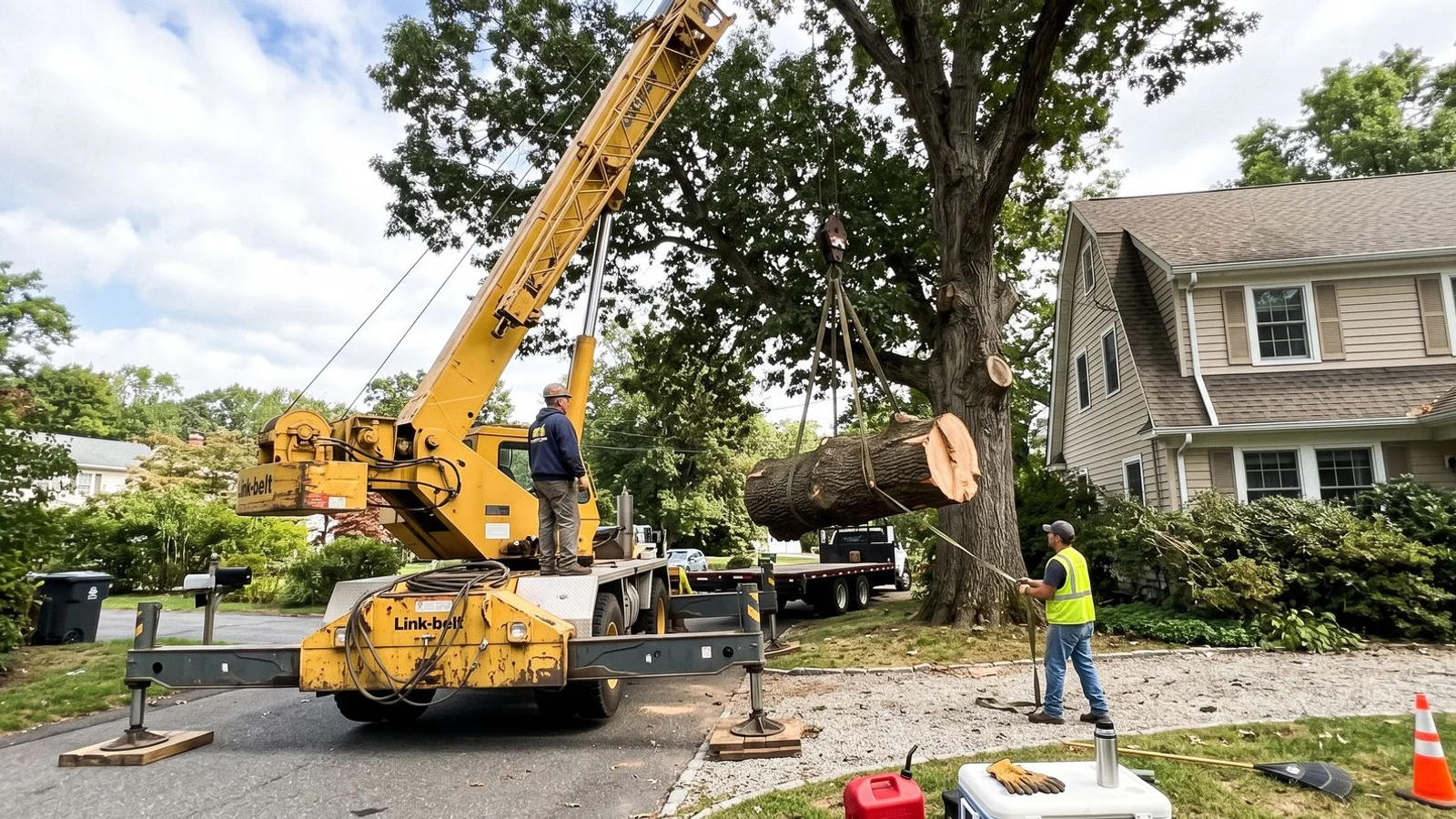
When a Crane Is Definitely Needed
- Very large trees over 60 feet with heavy canopies
- Trees over houses where sectioning through the canopy would risk roof damage
- Storm-damaged trees with unpredictable failure risk during hand-rigging
- Tight lots where drop zones are severely limited
- Trees near multiple structures or over property lines
- Trees with structural defects that could fail during dismantling
When a Crane Is Optional but Better
- Medium-large trees on tight residential lots
- Trees close to power lines
- Trees over specimen landscaping that would be damaged by rigging
- Time-constrained jobs where a crane finishes in half the time
- Jobs where the added cost of a crane is less than the added risk without one
When a Crane Isn’t Needed
- Trees under 40 feet in open yards
- Trees far from structures
- Straightforward removals on flat, accessible ground
- Small trees that can be felled whole
Why Crane Removal Can Be Safer
Standard rigging removes a tree by having a climber section it from the top down. Each section gets rigged and lowered on ropes. It’s safe when done right — but on very large trees or trees close to structures, the risk multiplies:
- Each section poses a risk to the crew and the structure
- Long removals mean more opportunities for something to go wrong
- Compromised trunks can shift or fail under the weight of the climber
A crane lifts sections cleanly away — no rigging through delicate landscaping, no swinging cuts over roofs. It’s often the safer choice on complex jobs.
Why It Can Cost Less on Complex Jobs
Yes, a crane rental adds $1,500–$5,000 to the job. But on complex removals, it can save:
- Crew time — hours or days
- Property damage risk — one dropped section on a roof is a $5,000+ repair
- Landscape damage — mats and protection cost less when there’s less to protect
- Utility coordination — crane picks avoid line contact more reliably
For a tree hanging directly over a house, a crane removal is often cheaper overall than the alternative.
Decision Framework
Ask three questions:
- Size: Is the tree over 60 feet with a heavy canopy?
- Setting: Is it directly over a structure or on a tight lot?
- Condition: Is the trunk compromised or the tree storm-damaged?
Yes to two or more = crane strongly recommended.
What Crane Setup Requires
- Access for the crane to a setup point (usually a driveway, side yard, or street)
- Overhead clearance for the boom
- Utility coordination if lines are near the setup or lift path
- Neighbor coordination if setup or lift crosses property lines
- Time — usually a half-day to full-day operation
Coverage in Westchester
Crane-assisted removals are common in older Westchester neighborhoods — Bronxville, Larchmont Manor, Scarsdale’s Fox Meadow, Rye’s Milton Point. Historic tight lots with mature specimen trees + close-set homes = crane territory.
Call 914-907-4131 for an estimate.
Related: crane-assisted tree removal service, crane removal on tight residential lots, large tree removal near power lines.