Do I Need a Permit to Remove a Tree in Westchester County?
Which Westchester towns require a tree removal permit, how DBH is measured, and how we handle the filing for you. Scarsdale, Mamaroneck & Rye rules explained.
The Short Answer
Some Westchester towns require a permit to remove a tree over a certain size. Others don’t. It comes down to your municipality and the tree’s diameter — and there are exceptions for hazardous or dead trees in almost every ordinance.
Rather than guess, our first step on any tree removal in a regulated town is to measure DBH and check the local rule. Here’s what to know.
Towns With Notable Tree Ordinances
Scarsdale is the strictest in Westchester. The Village of Scarsdale regulates removal of trees over 6 inches DBH on private property. Permit applications require site plans, arborist justification, and often a replacement-planting commitment. Enforcement is active.
Mamaroneck (both Town and Village) has a tree ordinance covering removal on private lots, with thresholds and requirements varying between the Town and the Village.
Rye (City of Rye) regulates larger trees and has specific permit requirements for shoreline and buffer areas.
Other towns (Bronxville, Larchmont, New Rochelle, White Plains) have varying and evolving rules — some cover public trees or street trees specifically, some address development-related clearing separately.
We check the current rule for your specific address before we quote any removal in a regulated town.
What DBH Is and How We Measure It
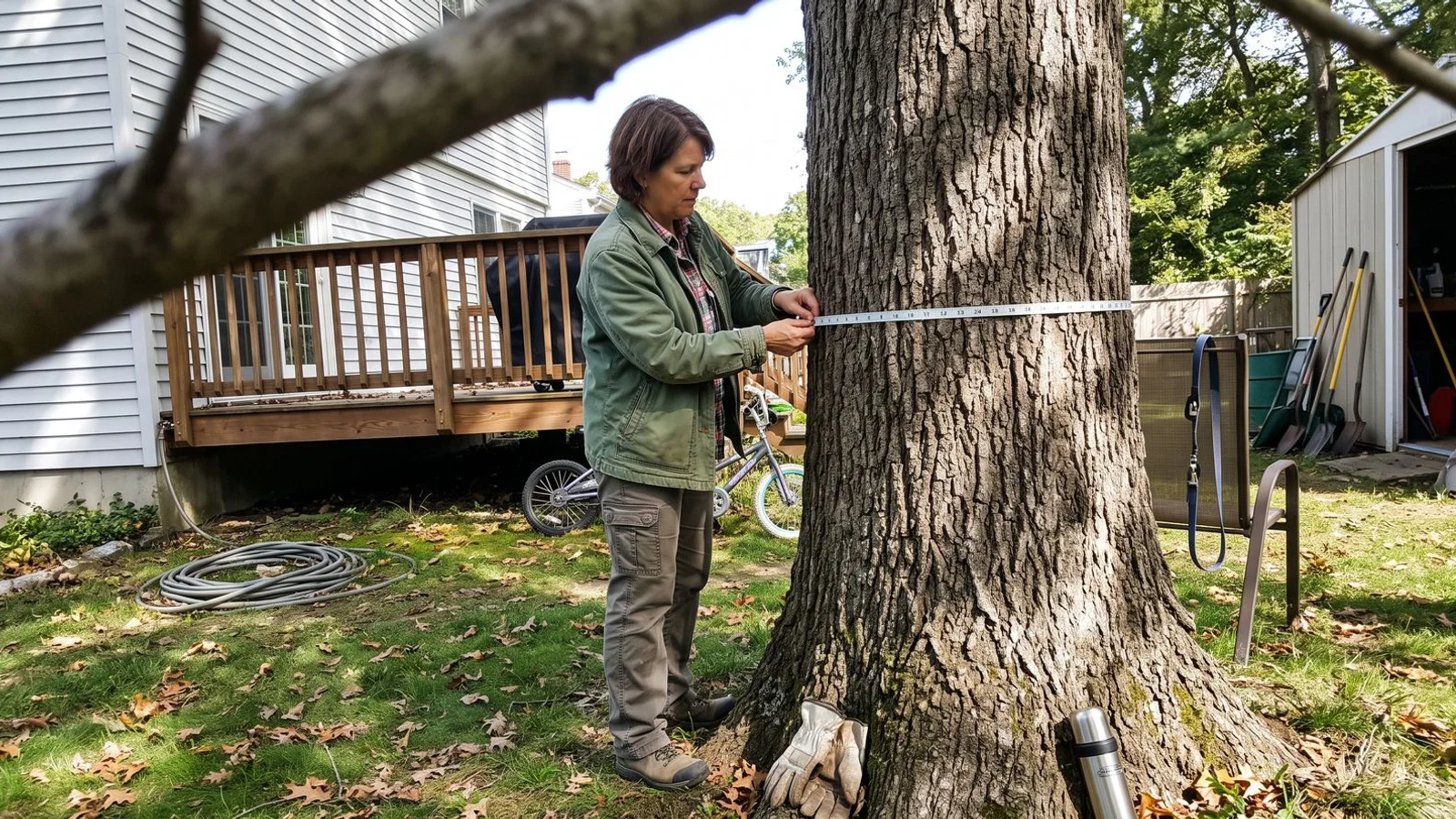
DBH stands for Diameter at Breast Height. It’s the diameter of a tree’s trunk measured 4.5 feet above ground level — about chest height on an adult. We use a DBH tape (a specialized tape that reads diameter directly from circumference) to measure it.
Why 4.5 feet? Because trunk diameter changes with height, and 4.5 feet is a global standard that makes measurements consistent between arborists and consistent with municipal ordinances.
For multi-stemmed trees, ordinances usually count each stem separately (or use the largest stem, depending on the town). For trees with a fork below 4.5 feet, we measure below the fork.
When You Don’t Need a Permit
Most Westchester tree ordinances include exceptions for:
- Immediately hazardous trees — trees threatening to fall on a structure or block emergency access
- Dead trees — usually with arborist certification that the tree is dead
- Certain undersized trees — below the ordinance’s DBH threshold
- Certain species (some ordinances exempt specific invasive species)
- Development-related removal — often handled by a separate development approval process
Documentation matters. Even for exempt removals, we photograph the tree and note the condition so there’s a record if a neighbor complains or the town questions the removal later.
How Our Permit Filing Works
For any permit-required removal we handle:
- DBH measurement and site notes during the initial estimate
- Ordinance check — we verify the current rule for your specific town
- Permit application preparation — including any required arborist justification
- Filing with the municipality on your behalf
- Follow-up — some permits require post-removal replacement plantings, and we track that
This is included on any tree removal in a regulated town — no separate charge unless the town’s own fees are unusually high (rare).
Why the Rules Exist
Westchester’s tree ordinances are about canopy preservation — the mature-tree cover that gives towns like Scarsdale and Bronxville their character. From a homeowner’s perspective, they’re occasionally inconvenient. From a town-wide perspective, they slow the erosion of a canopy that took a century to grow.
We’re aligned with that goal in principle. In practice, we help you navigate the rules efficiently so a legitimate removal doesn’t get bogged down in paperwork.
When You’re Not Sure
Call us. We’ll come measure DBH, check your municipality’s current ordinance, and tell you honestly whether a permit is required. There’s no charge for an on-site check as part of any removal estimate.
For a real-world example, see how permits interact with tree service in Scarsdale and the overall tree removal service page.