How Much Does Land Clearing Cost Per Acre?
Land clearing cost drivers — density, terrain, access, disposal — with small-lot vs. acreage ranges and what's included. Free estimates in Westchester County.
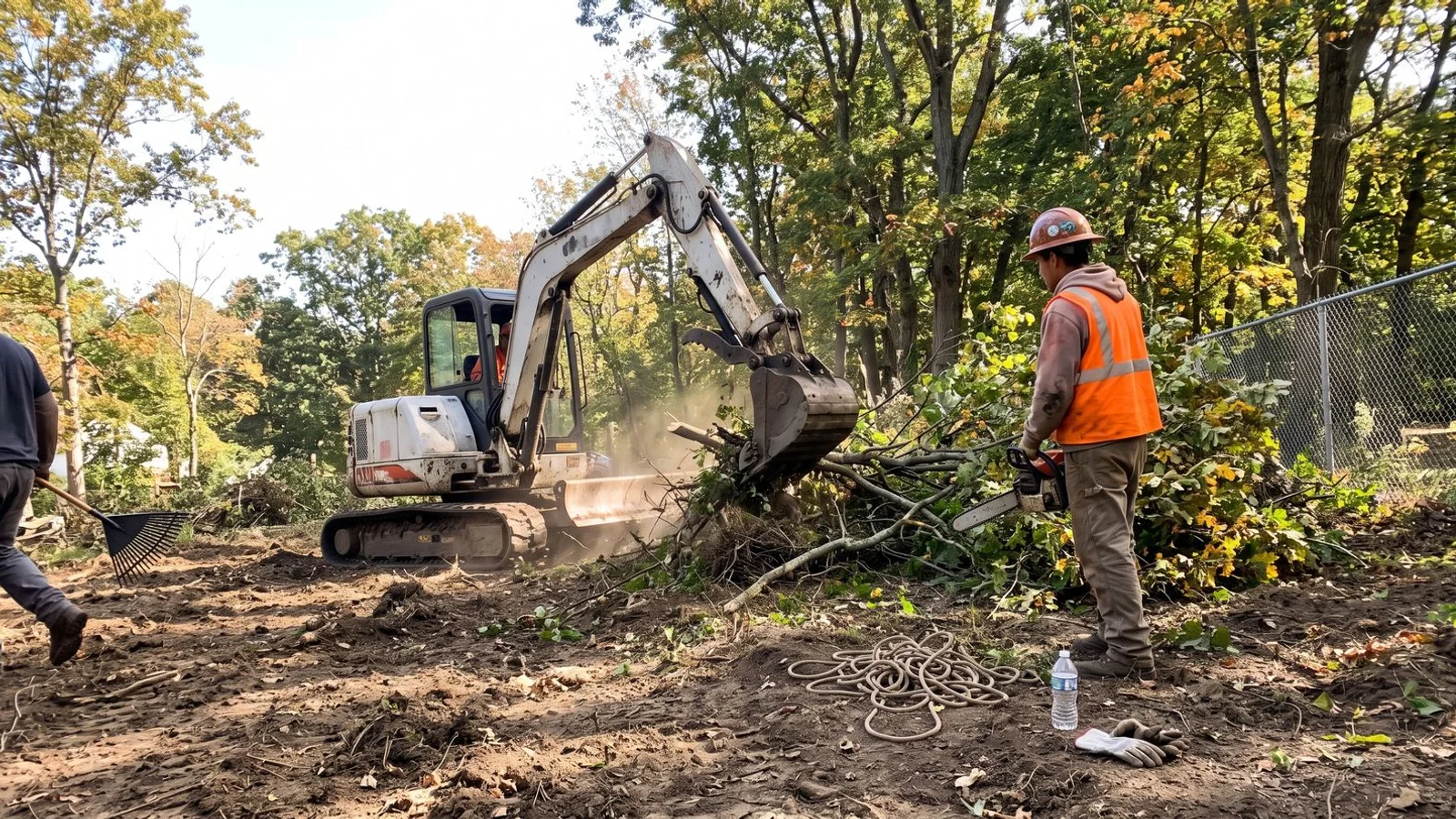
We know that the land clearing cost per acre often feels like a complete mystery to property owners.
Those quotes ranging from $1,500 an acre to over $10,000 for the exact same property size can be incredibly frustrating. The massive price gap usually comes down to the specific equipment used and how your contractor handles the debris.
Our crew will break down the exact costs for 2026, explain the hidden factors that drive up bids, and show you how to prepare your site efficiently. Let’s look at the numbers.
Typical Cost Ranges
Our typical acreage clearing cost in Westchester ranges from $1,500 to over $15,000 per acre depending on the forest density. Light brush clearing falls on the lower end, while heavy, mature forest removal hits the top of that scale.
Light Clearing (Brush, Small Trees, Few Large Trees)
Forestry mulching is highly efficient for these lighter jobs. A compact track loader can power through this vegetation quickly.
- Under 1 acre: $1,500 to $5,000
- 1-3 acres: $2,500 to $8,000 per acre
- 3+ acres: $2,000 to $5,000 per acre
Medium Clearing (Mixed Forest, Moderate Density)
We often deploy heavier machinery like excavators for mixed woodlands. Removing mid-sized stumps requires more diesel and time.
- Under 1 acre: $4,000 to $10,000
- 1-3 acres: $5,000 to $12,000 per acre
- 3+ acres: $4,000 to $8,000 per acre
Heavy Clearing (Dense Mature Forest)
Our crews face the toughest challenges in dense, mature forests with thick canopy cover. Taking down massive trees and grinding huge stumps requires specialized, heavy-duty tub grinders.
- Under 1 acre: $8,000 to $15,000
- 1-3 acres: $8,000 to $18,000 per acre
- 3+ acres: $6,000 to $12,000 per acre
These are typical Westchester ranges for 2026. Actual pricing always depends on your specific site conditions.
The 4 Cost Drivers
We calculate your final bill based on four primary factors: density, terrain, access, and debris disposal. Changing just one of these variables can drastically alter the final project price.
1. Vegetation Density
How many trees are packed into your acre, and how thick is the underbrush? Sparse woodland with a few large trees requires far less effort than a dense mature forest. A single operator using a skid steer with a mulching head can process light saplings quickly.
2. Terrain Challenges
Flat, dry land keeps equipment moving fast and costs low. Steep slopes, wet ground, or the rocky terrain common in New York add significant complexity. We have to bring in specialized track loaders to safely navigate muddy or uneven ground without sinking.
3. Equipment Access
Can the heavy equipment easily drive onto the site? Building a temporary access road for a large CAT 304 mini excavator adds immediate overhead. Rural properties with narrow, winding drives limit the size of the machinery allowed on site.
4. Debris Disposal Methods
Our cheapest option for handling debris is chipping and mulching it directly on-site. Hauling everything away in dump trucks is much more expensive, often adding $800 to $3,000 per acre just in transportation and dump fees. Burn permits provide the cheapest debris disposal where allowed. Getting approval to burn brush is incredibly rare to secure in Westchester.
Selective vs. Full Clearing
We see a clear price divide between saving specific trees and wiping the slate clean. Selective clearing costs 20% to 40% more per acre than a standard full clearing job.
Why Selective Clearing Costs More
Selective clearing involves preserving specified trees while removing the rest of the vegetation. The extra cost pays for the precision required to protect your valuable landscape assets.
- Marking and physical protection of preserved trees
- Precision equipment operation to avoid damaging the root zones of keepers
- A significantly slower overall work pace
This method is highly recommended when you are preserving mature specimen trees or a natural privacy buffer.
The Full Clearing Advantage
Full clearing takes everything down to grade. This straightforward approach allows operators to work at maximum speed. Clearing a fully open lot requires less precision, making it the cheaper option per acre.
What’s Typically Included
Our standard land clearing package covers the essential removal and basic site preparation. You will get a clean slate ready for the next phase of your project.
Here is what you can typically expect in a standard contract:
- Tree and thick brush removal
- Chipping or hauling of all organic debris
- Stump grinding for basic lot preparation
- Full stump removal if construction or foundations are planned
- Basic grading prep to level the ground
- General site cleanup
We always specify the exact depth of stump grinding in the paperwork. A basic lot prep usually leaves the ground flat, rather than perfectly graded.
What’s Usually Not Included
We want to be completely transparent about the services that require separate contractors or additional fees. Preparing a site for a new building often requires specialized trades beyond basic clearing.
These items are usually excluded from a standard clearing quote:
- Final grading: Preparing the exact foundation pad requires a specialized grading contractor.
- Rock removal: Sites with extensive New York rock outcroppings need heavy demolition equipment.
- Erosion control: Installing silt fences or hydroseeding is a separate environmental service.
- Permit fees: Local town fees are passed directly through to the property owner if applicable.
- Environmental remediation: Sites with regulated contamination require certified specialists.
Our crews will communicate with your other contractors to ensure a smooth handoff. Knowing these exclusions upfront prevents frustrating budget surprises later on.
Permit Awareness
We deal with strict local regulations daily, as most Westchester towns require permits for removing trees over a specific size. You can review the specifics in our tree removal permit guide.
Local Tree Ordinances
Towns like Scarsdale and Pound Ridge heavily regulate tree removal. You generally need a permit before cutting down any tree with a Diameter at Breast Height (DBH) of 6 to 8 inches or larger. Cutting without a permit can trigger massive fines and immediate stop-work orders.
Environmental Review and Wetlands
For land clearing on a lot larger than a certain size, additional environmental review may apply. As of January 1, 2025, the New York State Department of Environmental Conservation (NYS DEC) aggressively updated its freshwater wetlands regulations. They now regulate wetlands of “unusual importance” regardless of size, meaning even small seasonal soggy areas on your property might require state clearance.
We flag these exact permit requirements during the initial quote so there are no costly surprises. Protecting your timeline means securing the right paperwork before a single chainsaw starts.
Timing
Our timeline for a clearing project depends entirely on the size of your lot and the capacity of the machinery. A standard skid steer forestry mulcher can typically clear 1 to 4 acres per day under ideal conditions.
Typical Project Durations
Here is a general estimate based on average site conditions:
- Small lot (under 1 acre): 1 to 3 days on site
- Medium (1-3 acres): 3 to 7 days
- Large (3+ acres): 1 to 3 weeks depending on tree density
Weather Delays and Seasonal Advantages
Rain days will extend these timelines significantly because heavy machinery destroys wet soil. Winter clearing on frozen ground is often much faster. We prefer winter scheduling because the hardened earth prevents severe turf damage and keeps the equipment moving efficiently.
Getting an Accurate Quote
On-site visits are required for anything larger than a very small lot to provide a truly accurate price. Giving a blind quote over the phone almost always leads to inaccurate expectations.
During the walkthrough, our estimators need to evaluate several specific details:
- Site access for heavy transport trucks
- Tree density and the specific wood species
- Terrain slopes and natural drainage patterns
- Where the processed debris will be handled
- Proximity to adjacent structures and underground utilities
Call 914-907-4131 or use the contact form to schedule your site evaluation today. Taking the time to properly assess the land ensures you get a fair, transparent lot clearing price that actually sticks.
Related: land and lot clearing service, lot clearing for construction.